₿ Crypto & Web3
OKX
Global crypto exchange and Web3 platform
Some links on this page are affiliate links. If you sign up through one we may earn a commission, at no extra cost to you.
About OKX
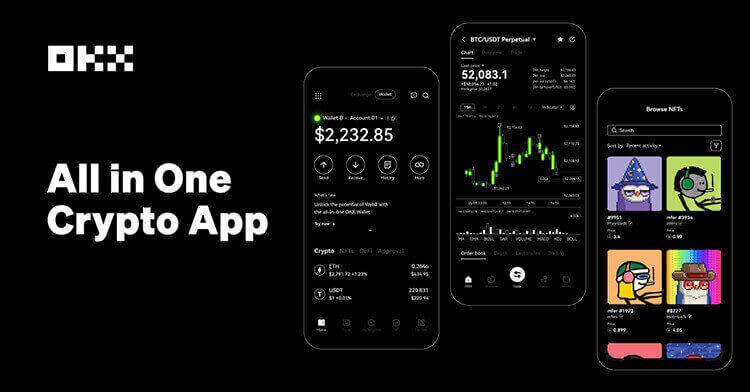
Global crypto exchange and Web3 platform
Key Features
- Spot trading
- DeFi
- NFTs
OKX is listed in the Crypto & Web3 category on Mega Deal. Alternatives in the same category are listed further down this page.
Pros
- The fee schedule is published in full rather than summarised. Regular users pay 0.2000 percent maker and 0.3500 percent taker, with nine VIP levels beneath that, reaching 0.0400 percent maker and 0.0700 percent taker at VIP 6, checked August 2026.
- Tier placement is computed from either assets under management or 30-day trading volume, using whichever measure is more favourable to the user, and is refreshed daily.
- Proof of Reserves is a recurring published programme rather than a one-off statement: the July 2026 report was the 45th in the series, covering 22 cryptocurrencies, with historical Merkle tree data available back to November 2022.
- Reserve claims are checkable by the account holder. OKX uses a zk-STARK zero-knowledge proof and publishes open-source tooling so a user can confirm their own balance is included in the Merkle tree rather than taking the total on trust.
- The July 2026 report states a 1:1 reserve ratio, with individual asset ratios shown between 100 and 112 percent and a total of 23.12 billion US dollars in primary assets, checked August 2026.
- Withdrawal capacity is published up front rather than discovered at the moment you need it: a 24-hour crypto withdrawal limit of 10 million US dollars for regular users, rising to between 24 million and 80 million across the VIP tiers.
Cons
- OKX states it may not make all of its services available in all markets and jurisdictions, and points to Section 3 of its Risk and Compliance Disclosure for the complete list. Check your own market against that document first; where the product set you want is restricted locally, a venue authorised specifically for your country is the better starting point.
- Identity verification is required, including a government-issued photo ID and evidence of residency such as a utility bill or bank statement. If holding assets without a centralised account is the priority, a self-custody wallet is the product for that, and the Web3 side of OKX sits closer to that model than the exchange side does.
- The lowest fees sit behind assets under management or 30-day volume thresholds, and a regular user pays 0.2000 percent maker and 0.3500 percent taker. Someone buying small amounts occasionally should compare venues on the entry rate they will actually pay rather than on the VIP table.
- This is a full trading venue, with RFQ block trades, multi-leg strategies and low-latency API access sitting alongside simple conversion. Anyone who only wants to buy occasionally and hold is navigating an interface built for people doing something considerably more involved, and a simpler brokerage will ask less of them.
In-Depth Review
OKX is a centralised cryptocurrency exchange with a Web3 side attached, and the only useful way to evaluate one is on what it provides as a venue: what it charges, how it holds customer assets, what it requires of you to open an account, and where it is available. Nothing below is a view on any asset, a forecast, or a suggestion to trade anything. Those questions are yours and they are not what a venue review can answer. What this page can tell you is whether the mechanics of this particular venue fit what you intend to do, and where a different kind of service would fit you better.
What it charges, and how the tiers work
The fee schedule is published rather than negotiated. A regular user, defined as holding 0 to 100,000 US dollars in assets or trading that volume, pays 0.2000 percent as a maker and 0.3500 percent as a taker. Below that sit nine VIP levels. VIP 1 pays 0.1000 and 0.2000 percent, VIP 3 pays 0.0600 and 0.1250, VIP 6 pays 0.0400 and 0.0700, and the top levels reach negative maker fees with taker fees under 0.0250 percent. All figures checked August 2026.
The mechanism behind the tiers matters as much as the numbers. OKX states users are categorised by both assets under management and 30-day trading volume, and that the calculation uses whichever of the two is more favourable. Tiers refresh daily, in a window between 8:00 and 10:00 PM UTC. In practice this means the tier is not something you apply for, and it does not lag your activity by a month.
The honest read of that table is that the headline VIP economics belong to high-volume participants. If you are the regular-user row, then 0.2000 and 0.3500 percent is your actual cost, and that is the figure to compare against other venues rather than the numbers further down the page.
How customer assets are accounted for
Custody is the question that decides whether an exchange is usable at all, and OKX addresses it with a recurring Proof of Reserves programme rather than a single assurance. The stated purpose is to demonstrate that a custodian holds sufficient funds to cover all account assets and deposit liabilities while remaining solvent. The July 2026 report was the 45th in the series, dated 7 July 2026, covering 22 cryptocurrencies including Bitcoin, Ethereum, USDT, USDC, XRP, Dogecoin, Solana and OKB. It states a 1:1 reserve ratio, with individual asset ratios shown between 100 and 112 percent and a total of 23.12 billion US dollars in primary assets.
The technically interesting part is that verification is not purely a matter of reading the report. OKX uses a zk-STARK zero-knowledge proof and publishes open-source tooling that lets an account holder confirm their own balance is included in the Merkle tree, with historical data available back to November 2022. That does not eliminate counterparty risk, and no reserve report can, but a monthly cadence with user-side verification is a materially different posture from an annual statement you cannot check.
What opening an account requires, and where it works
Two things are worth settling before you register. First, verification: OKX requires accurate and complete registration information to verify identity, and states that a copy of a government-issued photo ID and evidence of residency such as a utility bill or bank statement may be required. This is standard for a regulated centralised venue and is not optional.
Second, and more important, availability. OKX states plainly that it may not make all of its services available in all markets and jurisdictions, and directs users to Section 3, Regulatory Landscape, of its Risk and Compliance Disclosure for the complete list. This is not a footnote to skip. Which products are offered varies by country, and the answer for your market is in that document rather than in any general description of the platform. Read it for your own jurisdiction before you commit time to an account.
The product list spans simple and advanced ends. Convert handles quick conversions with zero trading fees and no slippage, which is the least involved way to exchange one asset for another. Spot trading is the standard order-book venue. An Earn section and an on-chain Earn section exist as product categories; what they pay and whether they suit you is outside anything this page can assess, and the terms of each product are the only place to answer that.
At the other end sit tools built for professionals: RFQ for custom multi-leg strategies and block trades, an Agent Trade Kit for automating trades, and API connectivity described as ultra-low latency. A separate Web3 platform runs alongside the exchange. OKX lists NMLS #1767779 and a San Francisco address on its site.
Who it fits
OKX suits someone who wants a large centralised venue with a published fee ladder, monthly and user-verifiable reserve reporting, and a product range that extends well past simple buying. The daily tier recalculation and the dual assets-or-volume basis make the fee structure genuinely responsive rather than an annual review. It is the wrong fit in three cases: if the services you want are restricted in your jurisdiction, which the Risk and Compliance Disclosure will tell you; if you would rather not complete identity verification, in which case self-custody is the different product you are looking for; and if you only ever want to buy a small amount occasionally, where a simpler brokerage asks far less of you than an interface built around block trades and low-latency APIs.
Why Choose OKX?
Judge a venue on venue things
Choosing an exchange is a question about fees, custody, account requirements and availability, not about any asset. On fees, OKX publishes the whole ladder: regular users pay 0.2000 percent maker and 0.3500 percent taker, with nine VIP levels beneath, reaching 0.0400 and 0.0700 percent at VIP 6, checked August 2026. Tier placement uses either assets under management or 30-day trading volume, whichever is more favourable, and refreshes daily rather than on application. If you sit in the regular-user row, compare on that row, not on the VIP table.
Reserves you can check yourself
Proof of Reserves runs monthly rather than as a one-off assurance. The July 2026 report was the 45th in the series, covering 22 cryptocurrencies and stating a 1:1 reserve ratio, with individual asset ratios between 100 and 112 percent and 23.12 billion US dollars in primary assets. OKX uses a zk-STARK zero-knowledge proof and publishes open-source tooling so an account holder can verify their own balance is in the Merkle tree, with history back to November 2022. Withdrawal capacity is also published up front: 10 million US dollars per 24 hours for regular users, rising to between 24 and 80 million across the VIP tiers.
Two things to settle before you register
Verification is required, including a government-issued photo ID and evidence of residency such as a utility bill or bank statement. And availability varies: OKX states it may not make all services available in all markets and jurisdictions, and points to Section 3, Regulatory Landscape, of its Risk and Compliance Disclosure for the full list. Read that section for your own country first, because which products you can use is decided there rather than by the general product page.
Who should look at something else
If the services you want are restricted where you live, a venue authorised specifically for your market is the better place to start. If completing identity verification is not something you want to do, a self-custody wallet is a different product answering a different need. And if you only ever want to buy a small amount now and then, the fee tiers reward volume you will not have and the interface is built around RFQ block trades and low-latency APIs, so a simpler brokerage will ask less of you. Choose OKX when you want a large venue with a published fee ladder and reserve reporting you can verify yourself.
Scan to open OKX on your phone
This QR code opens the same OKX link as the buttons on this page. Point your phone camera at it to continue on mobile.
Competitors & Alternatives
How OKX compares with the other Crypto & Web3 programs listed on Mega Deal. Every row links to that program's own page.
| Tool | What it does | Key features |
|---|---|---|
| OKX (this page) | Global crypto exchange and Web3 platform | Spot trading, DeFi, NFTs |
| Binance | World's largest cryptocurrency exchange | Crypto exchange, Spot & futures, Recurring revenue |
| Binance Spot Trading | Referral commissions on spot trading fees from referred users | Binance, Spot trading, Lifetime recurring |
| Binance Futures | Earn from referred users' futures & margin trading activity | Binance, Futures trading, High volume |
| Binance Pool | Mining pool referral rewards for BTC, ETH, and other PoW coins | Binance, Mining pool, BTC/ETH |
| Binance Earn | Savings, staking, and DeFi products with referral rewards | Binance, Staking, Savings |
| Binance Card | Crypto Visa debit card with cashback and referral bonuses | Binance, Crypto card, Visa |